As the leader of the Rebel Alliance, Princess Leia knew something about government. The original Star Wars, later retitled Star Wars: Episode IV – A New Hope, is a film about rebels struggling to overthrow the tyranny of the autocratic Galactic Empire led by Darth Vader. The new title conveys the theme of Luke Skywalker’s, and later Leia’s, emerging as the hopeful light against the Empire’s darkness. Inherent in the rebellion is hope for something better.
Colonial America endured its own struggle against the oppression of Britain and King George III culminating in the revolution and the Declaration of Independence in 1776. While trying to design its own, better government and draft its own constitutional document, the United Colonies exercised powers out of necessity, consent, and practicality rather than pursuant to authority conferred by a written constitution. For example, on 26 July 1775, the Second Continental Congress established the United States Post Office and named Benjamin Franklin as the first United States postmaster general.
The states did not ratify the first constitutional document, the Articles of Confederation and Perpetual Union, until 1 March 1781, expressly granting Congress the power to establish and regulate post offices and codifying a power that Congress was already exercising. (Articles of Confederation, art. IX).
The new government, although preferable to British rule, was not perfect, and the states sent delegates to Philadelphia on 25 May 1787 for a meeting to try to improve it. This conference became the Constitutional Convention that produced the U.S. Constitution, a constitutional document that reaffirmed and expanded the postal power. (U.S. Const. art. I, § 8, cl. 7). Franklin was the delegate from Pennsylvania.
On 17 September 1787 after the Constitutional Convention, Franklin famously quipped: “A republic, if you can keep it.” He was responding to a question about whether this new government was a republic or a monarchy. His response, though, was also the answer to another salient question: whatever the new form of government, are the people able to keep it? His comment implied that he hoped the people could sustain the new government but that it was tenuous, and its permanency was not guaranteed.
The U.S. has existed under the U.S. Constitution for close to 240 years, and this year marks the 250th anniversary of the Declaration of Independence, but the United States Post Office, now the United States Postal Service, has served the country longer. With these durations and stability and the fact that the U.S. is the oldest, continuous, constitutional democracy under a single written constitution, one easily treats democracy and mail as givens and conflates longevity with permanency.
Recently, the mail, as Franklin knew it and as contemplated by the U.S. Constitution, has had severe “financial challenges” and “service lapses”, prompting a proposal by the president that the Department of Commerce subsume it. (Bogage). In the alternative, the president has said: “There is a lot of talk about the Postal Service being taken private. It’s a lot different today, between [sic] Amazon and UPS and FedEx and all the things that you didn’t have.” (Bogage). Some countries have already addressed their postal woes: “Other Western countries, like Britain and Canada, have either privatized the mail or ended door-to-door delivery in recent years. The Danish postal service announced it would stop delivering letters after 400 years . . .” (Kurutz).
The U.S.P.S. lost nine billion dollars in fiscal year 2025. (United States Postal Service). The U.S.P.S. also has declining on-time delivery for single-piece letters and postcards. (Postal Regulatory Commission). Despite evidence of fiscal inefficiency, poor performance, and politicians’ proposals to reduce or eliminate governmental postal services, Americans rank the U.S.P.S as one of their favorite government agencies, second only to the National Park Service. (Cerda). I am one of those Americans.
I hope the U.S.P.S. survives as a separate agency delivering paper mail door-to-door. I am especially fond of the postcard medium because it is immediately distinguishable from junk mail and bills and because of its union of stamp, postmark, and manuscript on the same page– manuscript because people do not type postcards. I realize, however, that proposals for change might make good economic sense and that only a Luddite would insist on maintaining delivery of paper mail in the age of e-mail, but I also realize that reduction or elimination of mail is emblematic of the finite existence of even great institutions, including one contemplated in the U.S. Constitution.
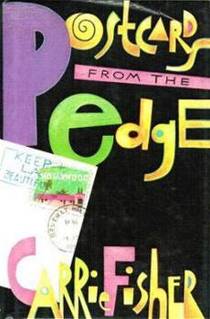
Carrie Fisher was an actress, novelist, and script writer whose most famous role was Princess Leia, and she was brilliant on screen and off. By most metrics of success, she was highly successful– she had it all. However, she suffered from addiction, and she wrote about it in her debut novel Postcards from the Edge.
She writes the prologue and first section of the novel in an epistolary style as postcards from her alter ego Suzanne Vale to family and a friend. She continues in the first chapter writing in the first person in the form of introspective journal entries: “I was into pain reduction and mind expansion, but what I have ended up with is pain expansion and mind reduction.” (Fisher 17).
One of the parts of the novel that struck me was a comment by Fisher/Vale akin to Franklin’s comment: “The thing about having it all is, it should include the ability to have it all. Maybe there are some people who know how to have it all. They’re probably off in a group somewhere, laughing at those of us who have it all but don’t know how to.” (Fisher 15).
I hope we are in the group laughing.
I. Librarian
Cited Works:
Articles of Confederation of 1781. National Archives, www.archives.gov/milestone-documents/articles-of-confederation.
Bogage, Jacob. “Trump Expected to Take Control of USPS, Fire Postal Board, Officials Say.” The Washington Post, 21 Feb. 2025, http://www.washingtonpost.com.
Cerda, Andy. “Americans See Many Federal Agencies Favorably, but Republicans Grow More Critical of Justice Department.” Pew Research Center, 12 Aug. 2024.
Constitution of the United States. National Archives, www.archives.gov/founding-docs/constitution-transcript.
Fisher, Carrie. Postcards from the Edge. Simon & Schuster, 1987.
Kurutz, Steven. “Mail Carriers Keep Making the Rounds, Despite a Murky Future.” The New York Times, 24 Dec. 2025, www.nytimes.com/2025/12/24/style/mail-carriers-keep-making-the-rounds-despite-a-murky-future.html.
Postal Regulatory Commission. The State of the Postal Service, www.prc.gov/state-of-the-postal-service.
United States Postal Service. “U.S. Postal Service Reports Fiscal Year 2025 Results.” About.USPS.com, 14 Nov. 2025, www.about.usps.com/newsroom/national-releases/2025/1114-usps-reports-fiscal-year-2025-results.htm.
You Might Like:
Post Two – THE SWEET WAIST OF AMERICA
Leave a Reply