Ahora su percepción y su memoria eran infalibles.
“Funes el memorioso”
Jorge Luis Borges
Robin Colcord plays the Alekhine Defence unsuccessfully against Sam Malone on Cheers, but Sam is cheating. He is relaying Robin’s moves by hidden wire to Norm and Pete who are using a chess computer in a separate room of the pub. They are then telling Sam what moves to play. (Cheers).
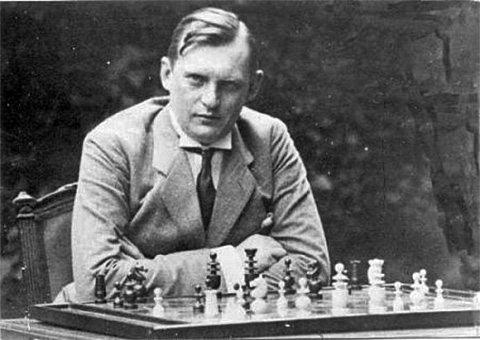
That Sam, a novice, beats Robin, an experienced player, by cheating, is not shocking. What is shocking is that the World Chess Champion Alexander Aleksandrovich Alekhine and his eponymous Alekhine Defence are in a prime-time sitcom in the United States. These chess esoterica are not recognizable to the prime-time audience.
Chess is mysterious to those who do not play. Austrian writer Stefan Zweig writes Chess Story (also translated The Royal Game), and he must have been a chess player because he includes the following advice from Dr. B:
If you queen now, he’ll take with the bishop on C1. You’ll recapture with the knight, but then he’ll advance his passed pawn to D2, attacking your rook. Even if you check with the knight, you’ll lose — mated within nine or ten moves. It’s almost exactly the same pattern Alekhine used against Bogoljubow in the Piestany Grand Tournament of 1922. (Zweig 11).
This advice includes names of pieces (queen, bishop, knight, etc.), algebraic notation (C1, D2), a reference to a famous tournament, and a reference to a famous game involving grandmasters Alekhine and Bogoljubow. But to non-players, it is meaningless.
Chess Story is a novella about Dr. B, an enigmatic passenger on an ocean liner. By happenstance, another passenger is the reigning world chess champion who engages in a consultation game with the other passengers. Dr. B intervenes in the game to prevent them from committing a blunder. Dr. B reveals to the anonymous narrator that he learned chess when the Gestapo imprisoned and isolated him, and his only reading material was a book of grandmasters’ games. Dr. B memorizes the games to preserve his sanity, but his chess monomania leads to madness. When he plays the champion one on one, Dr. B exposes the peril of an eidetic memory.
To the non-player, chess players who play well have eidetic memories because they are able to recall openings, famous games, and patterns of pieces on the board. Several studies dispel this notion, however. “Perception in Chess” by psychologists William G. Chase and Herbert A. Simon is the seminal study of the memory of chess players. Their conclusion is:
The data suggest that the superior performance of stronger players (which does not appear in random positions) derives from the ability of those players to encode the position into larger perceptual chunks [e.g. pawn chains, castled‑king structures, coordinated attacks], each consisting of a familiar sub-configuration of pieces. Pieces within a single chunk are bound by relations of mutual defense, proximity, attack over small distances, and common color and type. (Chase and Herbert 24).
The narrator in Zweig’s novella says something similar: “As if magnetically drawn, I stared at the board and saw there my familiar patterns—knight, rook, king, queen, pawn—translated into tangible form.” (Zweig 32). Chess players recognize chunks or patterns, and this perception of a game allows them to manage a large amount of complex information. According to Chase and Simon, the players’ analyses are perceptual and not computational:
. . . their superior performance . . . must lie in their ability to perceive structure in such positions and encode them in chunks. Specifically, if a chess master can remember the location of twenty or more pieces . . . then each chunk must be composed of four or five pieces, organized in a single relational structure. (Chase and Simon 2).
Chase and Simon conduct various tests among novice, intermediate, and master chess players. Their tests are extensive and complicated, and they append their empirical results to their study.
One of their experiments requires each level of player to study the position of pieces on a board for five seconds and then try to place pieces on a clear board in the same positions from memory. They find, among other things, that when the original pieces are in random positions, masters’ memories are no better than novices’ memories; however, when the pieces are in positions from an actual game– in chess playing patterns or chunks– the masters perform considerably better than novices.
As non-players do not recognize the patterns of chess, many readers do not recognize the structure of literature, assuming that it is a vast, unstructured, creative field. Studies dispel this notion too. For example, Vladimir Propp the Russian folklorist studies Russian folktales to identify their irreducible elements and describes his theory in The Morphology of the Folktale.
Specifically, Propp analyzes one hundred tales in a particular sub-genre of Russian folktale (not all types of folktales or all types of literature), and he deconstructs them into their constituent parts: themes, motifs, and functions. He calls this process morphology:
THE WORD “morphology” means the study of forms. In botany, the term “morphology” means the study of the component parts of a plant, of their relationship to each other and to the whole— in other words, the study of a plant’s structure. But what about a “morphology of the folktale”? Scarcely any one has thought about the possibility of such a concept. Nevertheless, it is possible to make an examination of the forms of the tale which will be as exact as the morphology of organic formations. If this cannot be affirmed for the tale as a whole, in its full extent, it can be affirmed in any case for the so-called fairy tales, that is, tales in the strictest sense of the word. (Propp XXV).
Motifs are narrative details, and themes are groupings of motifs. Neither a theme nor a motif, according to Propp, is structural, and both have infinite variations. Unlike a theme or a motif, a function is irreducible.
Propp defines a function: “By function we mean an act of a character, defined from the point of view of its significance for the course of the action.” (Propp 21). Functions are the structure of the folktale.
Propp then identifies the finite list of functions and calculates a specific number:
We observe that, actually, the number of functions is quite limited. Only some 31 functions may be noted. The action of all tales included in our material develops within the limits of these functions. (Propp 64).
Some examples of functions are: the hero leaves home (Propp 39); the hero acquires the use of a magical agent (Propp 43); the hero and the villain join in direct combat (Propp 51); and the hero is married and ascends the throne (63).
Both the “Perception in Chess” and Morphology of the Folktale show patterns in their respective fields that make complex information manageable. Pattern recognition in chess makes sense of vast amounts of chess theory, and taxonomies in folklore make stories meaningful through recurring forms. In both domains, the structure reduces the cognitive load so the mind can manage complexity.
The finite chunks in chess and the functions in folktales allow memorization and understanding, and the paradox of more limitation is that it leads to the infinite. As the narrator in Chess Story says:
All kinds of monomaniacs — people obsessed by a single idea — have always fascinated me, for the more one limits oneself, the nearer one comes, in a sense, to the infinite. Such seemingly isolated individuals build within their narrow material a strange, termite-like microcosm of the world. (Zweig 5).
That world might be a writer’s fiction.
Without limitations and patterns, we would be as confused as the medical staff tending to Dr. B in Chess Story after he has had a mental breakdown: “In your fever, you kept shouting odd formulas — C3, C4. None of us could make sense of them.” (Zweig 31).
I. Librarian
Works Cited:
Borges, Jorge Luis. Ficciones. Edited and with an introduction by Anthony Kerrigan, Grove Press, 1962.
Chase, William G., and Herbert A. Simon. “Perception in Chess.” Department of Psychology, Carnegie-Mellon University, Report No. 71‑16, June 1971.
“Indoor Fun with Sammy and Robby.” Cheers, directed by James Burrows, written by Glen Charles and Les Charles, season 8, episode 19, Paramount Television, 22 Feb. 1990.
Propp, Vladimir. Morphology of the Folktale. 2nd ed., translated by Laurence Scott, revised and edited with a preface by Louis A. Wagner, new introduction by Alan Dundes, University of Texas Press, 1968.
Zweig, Stefan. Chess Story. Translated by Phyllis and Trevor Blewitt, New York Review Books, 2006.
You Might Like:
Leave a Reply