For half a day at a time you lie on your bed, feeling like the jeune squelette in Baudelaire’s poem.
Down and Out in Paris and London
Working a shift in a bar or restaurant often entitles the employee to a shift drink, a perquisite of working in the industry. The shift in America in 2026 is probably eight hours– or fewer.
The shift drink for a plongeur in Paris in 1928, was ostensibly more generous:
. . . the patron was not mean about drink; he allowed us two litres of wine a day each, knowing that if a plongeur is not given two litres he will steal three. We had the heeltaps of bottles as well, so that we often drank too much– a good thing, for one seemed to work faster when partially drunk. (305).
But the shift was eleven hours– or more.
Eric Blair is destitute in 1928. He is living in Paris with little or no money and no job. He has a Russian friend, Boris, who once told him that, if he ever needed anything, to contact him. Close to eviction, having pawned almost everything, and not able to afford food and tobacco, he seeks Boris.
Blair writes about poverty, his search for a job with Boris, and his two restaurant jobs in Paris in Down and Out in Paris and London in 1933. As the title suggests, a portion of the book is about poverty in London too, but poverty in Paris is the more interesting topic.
Blair is living in a poor quartier, in an inexpensive hotel, paying rent by the week, and under the supervision of a strict concierge:
There were eccentric characters in the hotel. The Paris slums are a gathering-place for eccentric people– people who have fallen into solitary, half-mad grooves of life and given up trying to be normal or decent. Poverty frees them from ordinary standards of behaviour, just as money frees people from work. Some of the lodgers in our hotel lived lives that were curious beyond words. (251).
Blair’s poverty is reductive, allowing him to think of nothing else, and only in the present. He says in a sardonic tone:
For, when you are approaching poverty, you make one discovery which outweighs some of the others. You discover boredom and mean complications and the beginnings of hunger, but you also discover the great redeeming feature of poverty: the fact that it annihilates the future. (Down and Out 263).
Blair speaks fluent French, and he tries to find a job as an English tutor, a porter, and various other work, but he is unsuccessful. His only source of money is pawning his meager belongings, and he has done that already. His solution, of desperation, is relying on Boris to find him a job in a restaurant, a job for which he has no experience.
Boris was a soldier in the Russian Army, and in an ideal world, he would be back in the army:
. . . but he had also been a waiter long enough to acquire the waiter’s outlook. Though he had never saved more than a few thousand francs, he took it for granted that in the end he would be able to set up his own restaurant and grow rich. All waiters, I afterwards found, talk and think like this; it is what reconciles them to being waiters. (267).
On Boris’ advice, Blair and Boris go to a small café, “a well-known rendezvous of hotel managers and employees . . . The place was, in effect, an employment bureau, and the money spent on drinks was the patron’s commission.” (272). The patron does not select either of them for an available job, and they learn later that they needed to bribe him.
Boris also has contacts in the Russian community in Paris, including an ex-colonel of the Russian Army who is the patron of a restaurant he claims he is opening in a fortnight. While Boris and his friend converse in Russian, Blair “stood in the background, preparing to tell some big lies about my experience as a dishwasher.” (292).
The restaurant is the Auberge de Jehan Cottard, and Boris secures a job as maître d’hôtel and Blair as plongeur, but construction of the restaurant is not complete yet. While waiting for the auberge to open as their “money came to an end”, Boris gets a job working in the cafeterie of a hotel, the Hôtel X. Within three days, one of the plongeurs of the hotel leaves, and, on Boris’ recommendation, Hôtel X. hires Blair as a plongeur.
Blair provides detail of the “elaborate caste system in a hotel” in Paris. (309). The system begins with the patron at the top– devolving through manager, maître d’hôtel, head waiter, head cook, chef du personnel–and ends with the plongeur at the bottom. Other waiters and apprentice cooks are part of the hierarchy, but everyone is above the plongeur.
The chef du personnel at Hôtel X. explained that the job of a plongeur is “to fetch meals for the higher hotel employees, who fed in a small dining-room above, clean their room and wash their crockery.” (296). Blair learns that the shifts are from “seven in the morning till two in the afternoon, and from five in the evening till nine– eleven hours.” (300). Blair then describes the hectic, ceaseless tasks while working, and concludes: “It needs more brains than you think.” (302).
Blair is working in the “stuffiness of these labyrinthine cellars” with “fearful heat” that never falls “below 110 degrees Fahrenheit” (301), but most vivid are his descriptions of the squalor of his working environment in contrast to the luxury of the customers’ environment:
It was amusing to look round the filthy scullery and think that only a double door was between us and the dining-room. There sat the customers in all their splendour– spotless table-cloths, bowls of flowers, mirrors and guilt cornices and painted cherubim; and here, just a few feet away, we in our disgusting filth. For it really was disgusting filth. There was no time to sweep the floor till evening, and we slithered about in a compound of soapy water, lettuce-leaves, torn paper and trampled food. A dozen waiters with their coats off, showing their sweaty armpits, sat at the table mixing salads and sticking their thumbs into the cream pots. The room had a dirty, mixed smell of food and sweat. Everywhere in the cupboards, behind the piles of crockery, were squalid stores of food that the waiters had stolen. There were only two sinks, and no washing basin, and it was nothing unusual for a waiter to wash his face in the water in which clean crockery was rinsing. But the customers saw nothing of this. There were a coco-nut mat and a mirror outside the dining-room door, and the waiters used to preen themselves up and go in looking the picture of cleanliness. (307).
While the rich customers were paying exorbitant prices for their meals, Blair explains:
The others laughed when I wanted to wash my hands before touching the butter. Yet we were clean where we recognized cleanliness as part of the boulot. We scrubbed the tables and polished the brasswork regularly, because we had orders to do that; but we had no orders to be genuinely clean, and in any case we had no time for it. We were simply carrying out our duties; and as our first duty was punctuality, we saved time by being dirty. (309).
Blair cynically remarks about the rich customers:
But I imagine that the customers at the Hotel X. were especially easy to swindle, for they were mostly Americans, with a sprinkling of English– no French– and seemed to know nothing about good food. . . Perhaps it hardly matters whether such people are swindled or not. (320)
All of his work in the hotel is exhausting as he describes it in comparison to hunger:
Work in the hotel taught me the true value of sleep, just as being hungry had taught me the true value of food. Sleep had ceased to be a mere physical necessity; it was something voluptuous, a debauch more than a relief. (329).
Blair quits his job at the hotel when the Auberge Jehan de Cottard finally opens. Again, he works as a plongeur, similar to his job at the hotel:
The patron has engaged me as a kitchen plongeur, that is, my job was to wash up, keep the kitchen clean, prepare vegetables, make tea, coffee and sandwiches, do the simpler cooking, and run errands. (341)
His shifts are even worse: “from seven in the morning till half-past twelve the next morning– seventeen and half hours, almost without break.” (343). The kitchen might be worse too:
The kitchen grew dirtier and the rats bolder, though we trapped a few of them. Looking round that filthy room, with raw meat lying among refuse on the floor, and cold, clotted saucepans sprawling everywhere, and the sink blocked and coated with grease, I used to wonder whether there could be a restaurant in the world as bad as ours. (349)
The notable difference between the hotel and the auberge is the budget. The auberge struggled to open and relied on expectant employees to work without pay to build its interior:
Our coffee-grinder was borrowed from the bistro near by, and out dustbin and brooms from the concierge. After the first week a quantity of linen did not come back from the wash, as the bill was not paid. . . The electric company was still dunning us, and when the duns found out that we would buy them off with apéritifs, they came every morning. We were in debt at the grocery . . . These are the results of starting a restaurant on insufficient capital. (343).
After his two Parisian restaurant experiences, Blair says: “I am trying to consider the social significance of a plongeur‘s life”, and “I think I should start by saying that a plongeur is one of the slaves of the modern world.” (351). Specifically, he says: “His work is servile and without art; he is paid just enough to keep him alive; his only holiday is the sack.” (351).
Blair thinks that one would only be a plongeur if the job were necessary:
The question is, why does this slavery continue? People have a way of taking it for granted that all work is done for a sound purpose. They see somebody else doing disagreeable job, and think that they have solved things by saying that the job is necessary. Coal-mining, for example, is hard work, but it is necessary– we must have coal. Working in the sewers is unpleasant, but somebody must work in the sewers. And similarly with a plongeur‘s work. Some people must feed in restaurants, and so other people must swab dishes for eighty hours a week. It is the work of civilisation, therefore unquestionable. This point is worth considering. (351).
He goes on to describe two examples of “luxuries which are not luxuries”: one that involves a rickshaw puller and one that involves a gharry pony (Blair lived for a while in India and Burma). He concludes that “[t]hey afford a small amount of convenience, which cannot possibly balance the suffering of the men and animals.” (353). He labels them the oxymoronic “very poor luxuries”. (353).
Blair applies these thoughts to hotels and restaurants: “For, after all, where is the real need of big hotels and smart restaurants? They are supposed to provide luxury, but in reality they provide only a cheap, shoddy imitation of it.” (353).
Blair posits that the only reason rich people support “this instinct to perpetuate useless work is, at bottom, simply fear of the mob.” (355) He summarizes his idea:
A plongeur is a slave, and a wasted slave, doing stupid and largely unnecessary work. He is kept at work, ultimately, because of a vague feeling that he would be dangerous if he had leisure. . . I say this of the plongeur because it is his case I have been considering; it would apply equally to numberless other types of worker. (356).
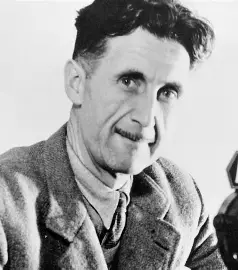
And the reader knows Eric Blair by his pseudonym, George Orwell.
I. Librarian
Works Cited:
Orwell, George. Homage to Catalonia; Down and Out in Paris and London, Mariner Books / Houghton Mifflin Harcourt, 2013.
You Might Like:
Post Three – WHAT THE HELL IS WATER?
Leave a Reply