The novel Satanic Verses won the Whitbread award for the Best Novel in 1988. The novel, apart from its critical acclaim, was popular and famous because Ayatollah Ruhollah Khomeini issued a fatwa condemning its author, Salman Rushdie, to death in 1989.
The Best Novel award was one of the subcategories in the Whitbread awards, and Satanic Verses, Rushdie’s fourth novel, was the favorite to win the overall award for the Whitbread Book of the Year– but it lost.
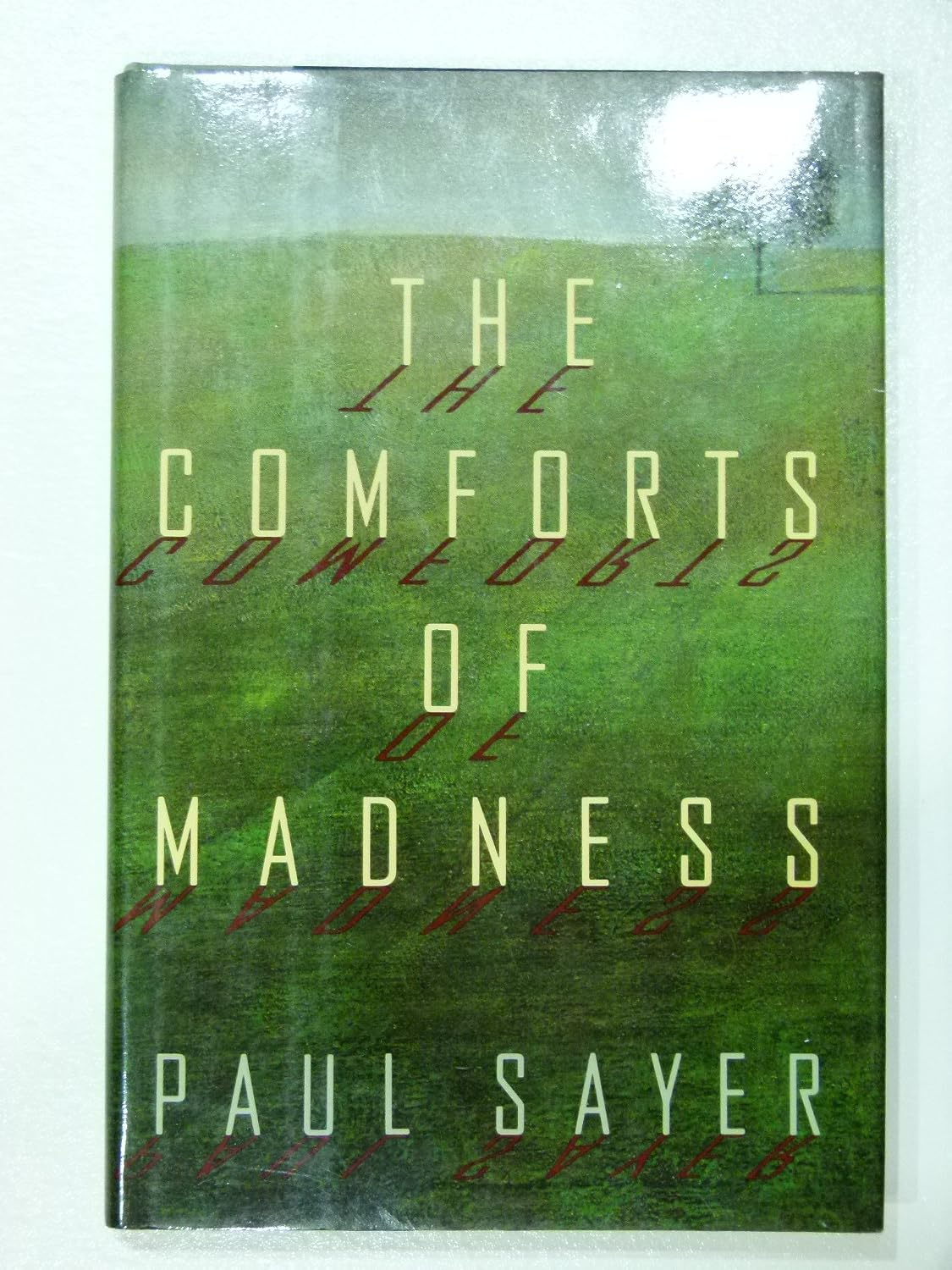
Another novel won the Whitbread award for First Novel, another subcategory, and it beat Satanic Verses to win Book of the Year. The novel is The Comforts of Madness by Paul Sayer.
Drawing on his experience as a psychiatric nurse in a hospital in the United Kingdom, Sayer tells the bleak story of Peter, a catatonic patient who is confined to a hospital and who has been selected for experimental treatment. Peter has no support from family or friends, and he has no advocate or guardian. He relies on hospital staff for everything: eating, dressing, locomotion, defecating, urinating, etc.
Sayer shares Peter’s thoughts about the hospital staff:
And those that did see me, enacted their business with me, plied their trade as it were, did they ever pause to wonder at this flaky receptacle that passed for a body, to ask themselves if there was any kind of a soul inside, bearing witness to the suns and moons that passed before its eyes? (Sayer 7).
Without his input or consent, the government selects him for an experimental treatment program at One World Rehabilitation Center, an in-patient facility, where the goal is for patients to achieve “social realignment status”. (Sayer 47). To that end, the staff abuses him, subjecting him to force feeding, painful machines to make him walk, and nocturnal recordings to prevent his bed wetting, among other things.
Sayer several times reveals Peter’s thoughts in legal terms to describe his condition. Peter thinks:
I had no inalienable right to contentment, I knew that, but these people were taking great exception to me and it looked as if they were not going to rest until they had come up with some permanent arrest of my catatonic state. [emphasis added](Sayer 37).
In fact, Peter realizes that he has no rights:
They should have known better than to fool around with someone like me. What right had they? But then, what were my rights? [emphasis added](Sayer 30).
Peter understands the staff’s self-justification for their actions:
They, like all before them, made their decisions certain in the knowledge that they were acting in my best interests. And it came easily to them, for I did not, could not, speak up in my own defense. [emphasis added](Sayer 37).
While these terms are clear and accurate, they indirectly raise the most significant flaw in Peter’s care: he has no advocate (to use a legal term)– no attorney-at-law, no attorney-in-fact, no guardian, no conservator.
Peter is imprisoned in One World and his own body. He is excluded from diversions available to other patients, relegated to being a silent observer only. He spends his time, when not enduring tortuous treatment, recalling episodes of his life which he calls “baubles”:
I must return to the toil of recalling the events of the day, that gaudy bauble that hands yet aloft in the dark vault of my head, waiting, tinkling and dangling, refusing to go away until I have reached for it. Now I stretch and pull it down for you and I to see it bright and terrible in my poor mind’s eye. And there are more. I come across them from time to time in some forgotten abyss at the end of some innocent-looking tunnel. They are often tarnished, given to disappearing before my eyes, and sometimes I wish they had not been disturbed but left to sink in the mud rather than come to light to mock and dismay me with their cheap appearance and unreasoned array. But they go nowhere, simply hide, lie in wait, displaced but not destroyed. (Sayer 7).
These memories, a “calamity of baubles”, torment Peter. (Sayer 73). He relives the trauma of his life in them and reaches a point where he no longer knows whether they actually occurred:
I was no longer quite myself, not up there in my head nor in that bony thin house they insisted was my body, the residing place of whatever they believed I really was, a soul, a vampire, a trickster perhaps. I had not been quite myself since those hours, that day, however long it was, when I had been subjected to the acrimonious details of my past, my history, whatever it may be called. Perhaps I had really seen nothing, an embellishment of nothing, and found it simply appropriate to explain myself with these excuses, these images, these baubles cast against the sky. I don’t know what was true, have no idea of the nature of “truth.” Those things in my mind– I couldn’t trust them, not things like that so neatly arranged, two-dimensional, obvious to the point of being on declarable as null and void. That past I saw, if it was really mine, was not a past in which I could place any trust– it would only let me down, I know it would. To forget, if at all possible, that would be best. (Sayer 94).
The staff accuse Peter of malingering, and when another patient writes a letter reporting the staff’s mistreatment of patients and signs Peter’s name, they take it as irrefutable evidence that Peter has been duping them. They leave him in the cold rain, unable to shelter himself, until he becomes ill, needing treatment for pneumonia at his original hospital.
After years of isolation from family– or anyone who could corroborate his baubles, he finally has a visitor who might be his sister Alison:
I was coming insidiously impressed. No one had ever recounted these details of my past life before, these baubles now formed into words, pouring innocent and enticing from the mouth of this pretty woman. Could it be possible? Might she really be Alison? My blood raced, lightly though, making me feel buoyant, fragile, new, newer than I had ever known. (Sayer 116).
After sharing facts about Peter’s past with him, Alison denies to the staff any relationship with him, leaving him alone with no one protecting his best interests or helping him cope with his traumatic past.
I. Librarian
Works Cited:
Sayer, Paul. The Comforts of Madness. 1st American ed., New York, Doubleday, 1990.
You Might Like:
Leave a Reply