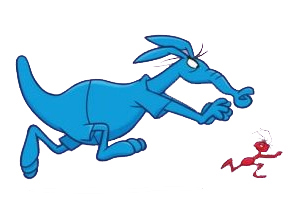
Are we the Aardvark chasing the elusive Ant, or are we “lords of the future”?
“The Pink Panther and Friends” was an animated television series from 1974 until 1976. It included the adventures of the Pink Panther, but also other short films about his friends, including “The Ant and the Aardvark”.
Similar to the Road Runner‘s outrunning– and outsmarting– Wile E. Coyote, the Ant always eludes the Aardvark. The wiles of the Ant and the Aardvark’s futile attempts to catch him remind me of a quotation by Fyodor Dostoevsky.
Dostoevsky wrote Pages from the Journal of an Author, a collection of essays, which contains the quotation. I will share the first part:
For what is a social ideal and how shall we understand the word? Surely its essence lies in men’s aspiration to find a formula of political organisation for themselves, a possible organisation which shall be faultless and satisfactory to all– is it not so? But people do not know the formula. Though they have been searching for it through six thousand years of history, they cannot find it. (Dostoevsky. Pages from the Journal, 100).
Dostoevsky recognizes that one point of agreement among humans is that they all share the struggle to find the perfect social order– one “satisfactory to all”– and the other point of agreement is that all humans share disagreement about that order.
I wrote about opting in to a social contract to avoid a life that is nasty, brutish, and short. (Post Eleven – PRO CHOICE). In my post, Thomas Hobbes, John Locke, and Thomas Jefferson presume to know how to design the social contract. Dostoevsky believes that the ideal social contract is elusive and unattainable.
Or maybe Hobbes, Locke, and Jefferson would agree with Dostoevsky that the ideal social contract is impossible, but believe also that a good, imperfect, social contract is preferable to none at all. As the Duke of Albany says in The Tragedy of King Lear, “striving to better, oft we mar what’s well”. (King Lear. Act I, Sc. 4, Line 369).
Unlike the humans, the ant knows the order. And now I share the second part of the quotation:
The ant knows the formula of the ant-hill, the bee of the hive– though they do not know it after the manner of human knowledge, they know it in their own way and desire nothing beyond– but man does not know his formula. (Dostoevsky. Pages from the Journal, 101).
What separates humans from animals is our awareness of mortality, our verbal language– and our ignorance of the formula. We continue to try different forms of social contract in our attempt to live a good life together, but the ant knows, and has always known, the one way to be an ant in the community of ants.
Dostoevsky also wrote the novel Crime and Punishment. Rodion Roskolnikov, the main character of the novel, is a destitute, former law student who murders a pawnbroker and steals certain items from her. He believes that, with his new wealth, he will do good deeds, and he tries to convince himself that certain crimes are justifiable if they are committed to accomplish the goals of “extraordinary” men.
Roskolnikov has written an article in which he divides the world of humans into two categories: ordinary men, and extraordinary men:
That consists in people being, by the laws of nature, divided in general into two categories: into a lower (of ordinary people), that is, into material serving only for the reproduction of its own kind, and into people properly speaking, that is, those who have the gift or talent of saying something new in their sphere. (Dostoevsky. Crime and Punishment, 220).
He also says in the article:
I simply intimate that the “extraordinary man” has the right . . . I don’t mean a formal, official right, but he has the right in himself, to permit his conscience to overstep . . . certain obstacles, but only in the event that his ideas (which may sometimes be salutary for all mankind) require it for their fulfillment. (Dostoevsky. Crime and Punishment, 219).
Roskolnikov’s rationalization does not save him, and he is overcome by guilt. But in his article he also says: “I do not in the least insist that the extraordinary people are absolutely bound and obliged to commit offences on any and every occasion.” (Dostoevsky. Crime and Punishment, 219). This statement raises interesting questions.
Are we right to seek what the ant knows? If seeking what the ant knows is the ideal of how a species should live, then the answer is yes.
If we have “the gift or talent of saying ‘something new’”– and at the expense of discarding the reactionary plan to make America great again by restoring a mythical, ideal past– do we have an obligation to be extraordinary?
Raskolnikov further explains his two categories of men: “The first category are always the masters of the present, but the second are the lords of the future.” (Dostoevsky. Crime and Punishment, 221).
I. Librarian
Works Cited:
The Ant and the Aardvark. DePatie-Freleng Enterprises. Seventeen theatrical shorts, release 1969-1971. Later included in multiple Pink Panther television packages.
Dostoevsky, Fyodor. Crime and Punishment. Translated by Jessie Coulson, edited by George Gibian, 2nd ed., Norton, 1975.
Dostoevsky, Fyodor. Pages from the Journal of an Author. Google-digitized scan, Internet Archive, archive.org/details/pagesfromjourna00murrgoog.
Shakespeare, William. The Tragedy of King Lear. Edited by G. Blakemore Evans, Riverside Shakespeare, Houghton Mifflin, 1974.
You Might Like:
Post Two – THE SWEET WAIST OF AMERICA
Post Five – FROM CARRIE FISHER
Leave a Reply